If you recognize the name, I applaud your literary diversity. For those of you who don’t know the name Sancho Panza, don’t feel bad. Sancho Panza was the pudgy, comic relief sidekick who accompanied Don Quixote on his journeys in Miguel de Cervantes’ satirical novel, Don Quixote, written in 1602, that inspired the Broadway musical and movieThe Man of La Mancha.
I’ve often felt that 21st Century Schools’ Director, Anne Shaw, is somewhat like Don Quixote in her philosophies where education is concerned. Where Don Quixote was “tilting at windmills” (his dragons) Ms. Shaw’s dragons have been slow change and the continual barrage of excuses such as “that’s the way we’ve always done things”, “Oh that’s wonderful, but WE can’t do that in our school”, “we don’t have time, we have to get our students ready for their tests”, “we can’t do that because of our schedule”.
Other dragons are misconceptions about professional development. Most educators seem to believe that "one-shot", "drive-by","muti-pack" professional development, or one day per year devoted to professional development, is adequate. The research, and the reality in classrooms, clearly show that this type of professional development will not make things better.
We are constantly being asked how to incorporate change into the curriculum without changing the curriculum or how teachers can “just add something” to what they are already doing to bring their classroom into the 21st century. The short answer to those two questions is, you can’t. If you are going to build a house, you start with the foundation, not the roof. The same applies to education. Click the Read More button . . .
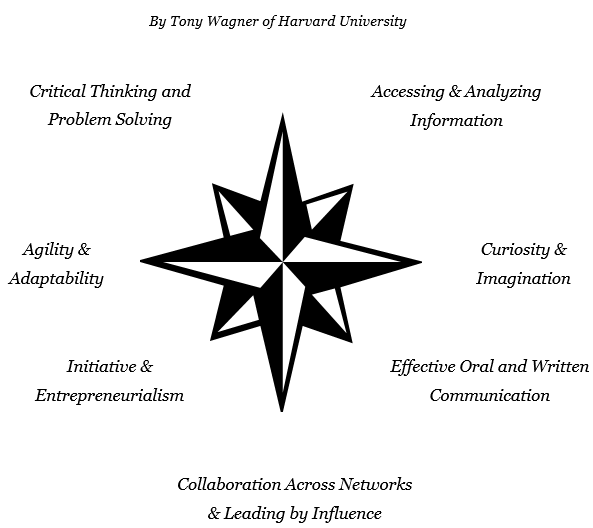
“At some level, once you realize that you’re in water too deep to stand, you have to have a very different approach, which is basically: Plans don’t work, mapping doesn’t work. You need a compass and a trajectory and some values to figure it out as you go along.”
Joi Ito, the new Director of the MIT Media Lab, interview with Popular Science, December 2011
Map - a plan; to arrange a method or scheme beforehand.
Compass - an instrument used for finding direction
The "water that is too deep to stand in" is the constant change that is occurring at a rapidly increasing pace. Our schools confront challenges that our education system was never designed to and may not be equipped to answer.(1) A compass is the tool we need today to guide us through these rapid changes . . .
2011 was an incredible year for us! We found ourselves suddenly thrust into the international/global community. The people we met, the schools we visited, the students we met, and the incredible hospitality we received in so many countries was fabulous.
In addition to meeting people on the streets and in shops and schools, we were very honored to have met and dined several times with very high level representatives of the government, education associations, university presidents and more! We probably spent more time outside the USA than in the USA this year. Our professional engagements ranged from keynotes at international conferences, to a country-wide needs assessment of schools, to teacher workshops! Best of all we had an opportunity to visit many schools, and observe classrooms, in each country!
Turkey - Malaysia - India - Vietnam - and more on the schedule!
Ankara, Turkey, May 1, 2011 - Anne Shaw presents her keynote at the International Innovation in Education Forum II. The entire presentation may be viewed here. Kuala Lumpur, Malaysia
Here Anne Shaw is enjoying a fine dinner and enjoyable conversation after her presentation to the Director General (right) and Dr. Kamal Jit Singh, CEO of Agensi Innovasi Malaysia.
The presentation was a report back on the extensive tour of Malaysian classrooms and schools, a prelininary Needs Assessment of Malaysian education.. On the tour we visited 17 schools, observed 59 lessons and interviewed small groups of students, teachers and parents.
A brief side trip to see India!
Anne Shaw conducting workshop with teachers, principals AND students from The Galaxy Education System in Rajkot, Gujarat, India. . We also were conducted on tours of many wonderful sites, including the Taj Majal and the Riki Ram Music Store | Penny Honeycutt and Anne Shaw are trying to figure out how to put on their saris for the Navratri Festival. |
Hanoi, Vietnam, December 2011
Anne Shaw is a keynote speaker at the International Conference on Textbooks for the 21st Century. Hanoi, Vietnam, December 2011 .
Let us share with you some delightful moments from our visits to other countries!
Beypazari, Turkey - Call to Prayer. This was an amazing experience listening to the beautiful call to prayer from the top of the hill!
Ankara, Turkey
| Meeting Students in Ankara, Turkey
Jerry Self, of 21st Century Schools., meets some very friendly (and funny) students from Suleyman Uyar Elementary in Ankara, Turkey. |
Somewhere in Malaysia! Here I was amazed, delighted, and honored to be able to observe and photograph this Hindu prayer ceremony. This was a special ceremony for the 6th graders who would be taking their most important exams next week!
Somewhere between Agra and New Delhi - This is my friend Penney Honeycutt, Principal at Inner Harbour, a fabulous school in Douglasville, Georgia (USA).
.. These are students at The Galaxy Education System in Rajkot, Gujarat, India. They are celebrating Navratri.
Steven Weber wrote an excellent blog post on ASCD Edge entitled "Would I want my child in this classroom?" Educators AND parents need to think about this question and then demand a real education for their children. We must face the facts that what we are doing now in education is not working, and we must care enough to be willing to make the necessary changes. If we structured education correctly we would not have to spend so much time and money on programs like RtI (Response to Intervention) and Race to the Top (which provided no funding to 38 states). No amount of programs, policies, analyzing of data, cutting out recess, cutting out nap time for kindergarteners, practice tests or drilliing students is going to help students learn. Until we create schools and curriculum that allow teachers to teach and students to learn nothing will improve. We have to realize that putting students through a daily routine of changing class 7 or 8 times a day does not allow for the kind of meaningful, in-depth curriculum and instruction that results in students learning. Nor does it provide students a productive context within which they can grow academically, socially and personally. In authentic 21st century schools and classrooms students and teachers will realize the joy in learning, discover their unique gifts, develop creativity and so much more.
A cartoon about the insanity of our standardized testing program. You may view it online and click on it to enlarge to read it more easily. Here is an excerpt from the "ad": With ADS you get minute-by-minute teaching guides, thousands of practice tests, and other materials for turning your school into a 21st-century test-preparation factory. . . . www.drilltodeath.com
This web site and blog have been created to identify and articulate the meaning of the term "21st century school." From there we will explore the "what", "why" and "how" of creating authentic, meaningful education for our 21st century students. We invite your ideas, information and suggestions.
Have you watched the steady destruction of education in the United States since the inception of the No Child Left Behind Act? Not only did nothing improve, things got much worse. In my own work as a professional staff development consultant and curriculum designer I have worked with educators from all over the United States as well as from many other countries. I have watched in horror and disbelief as education has been steadily undermined. I have watched teachers go from being enthusiastic, creative and open-minded to being angry, depressed, and afraid. Now, instead of creatively designing truly rigorous, relevant, curriculum teachers are, for the most part, focused on one thing - getting their students to memorize as many facts as possible. Their belief is that if they do this the students will perform better on their standardized tests.
I am baffled by the fact that so-called education reformers turn a blind eye to the schools that truly are succeeding. About a year ago I attended a conference at one of the largest school districts in the nation. The new superintendent began to speak; he remarked that the charter schools in their district were doing an excellent job. He said that students at the charter schools were learning at high levels, and he said that he expected rest of the schools in the district to achieve the same results. But, instead of saying that they should be looking at how the charter schools were accomplishing this great success so that the same strategies could be implemented district-wide, he explained different strategies for the rest of the district. I was astounded when he announced that they were going to start giving new cars to students who took - and passed - 5 AP exams! He also stated that they were going to be intensively evaluating all the teachers; he expected that about 20% of the teachers would receive very bad ratings, and that they would give them assistance, but if they did not improve they would be fired.
I will not disagree that there are some people in classrooms who should NOT be there! I actually observed a middle school class in that district that same week. I could hardly believe how this truly awful that teacher was. She stood up in front of the class and lectured for over an hour. Many of the students had pulled their hoods up over their heads and laid their heads down on their desks to sleep. Others just sat there looking utterly miserable. I was miserable, too! There was definitely no thinking or learning happening in that classroom.
Why is it that administrators, policy makers and many educational organizations think that the answer is "more of the same". Make the school day longer, make those kindergarten children hit the books harder, take away the kindergarten nap time and play time, let's get rid of recess, art, music, play. Let us do more drilling of the students on their basic skills, let us get the students to move as quickly as possible through the textbook, memorizing as much as they can. "We just do not have time to do any inquiry or project-based learning. We must get these kids ready for their tests."
How is it that supposedly intelligent, educated people insist on ignoring the research? There are schools all over this country achieving great success. They can be found in areas of every social and economic strata. They are not test prep factories; their students are engaged (unlike the students in the middle school class that I observed) in very rigorous, problem- and project-based curriculum.
There is more than ample research to support the development of successful schools. There are schools in existence that are structured as truly 21st century schools - and their students are succeeding at incredible levels. They are not focusing on prepping for the test, they are involved in rigorous, relevant, real world, in-depth learning. Their test scores are excellent. Their graduation rates are excellent. The ACT scores are excellent. They have developed critical 21st century skills such as problem solving, critical thinking, working collaboratively, communicating, creating and designing. They go on to college.
This web site and blog, Becoming a 21st Century School, will gather the research into one place. This web site and blog will bring to you evidence of actual schools that are 21st century and successful.
|